Growth Strategies for M&A and Investment Banking Firms: A Framework for Growth
A growth strategy consultant’s guide to scaling M&A and IB firms through deal flow, diversification, and structured frameworks.
6 min read
Christine Hollinden : Published Updated
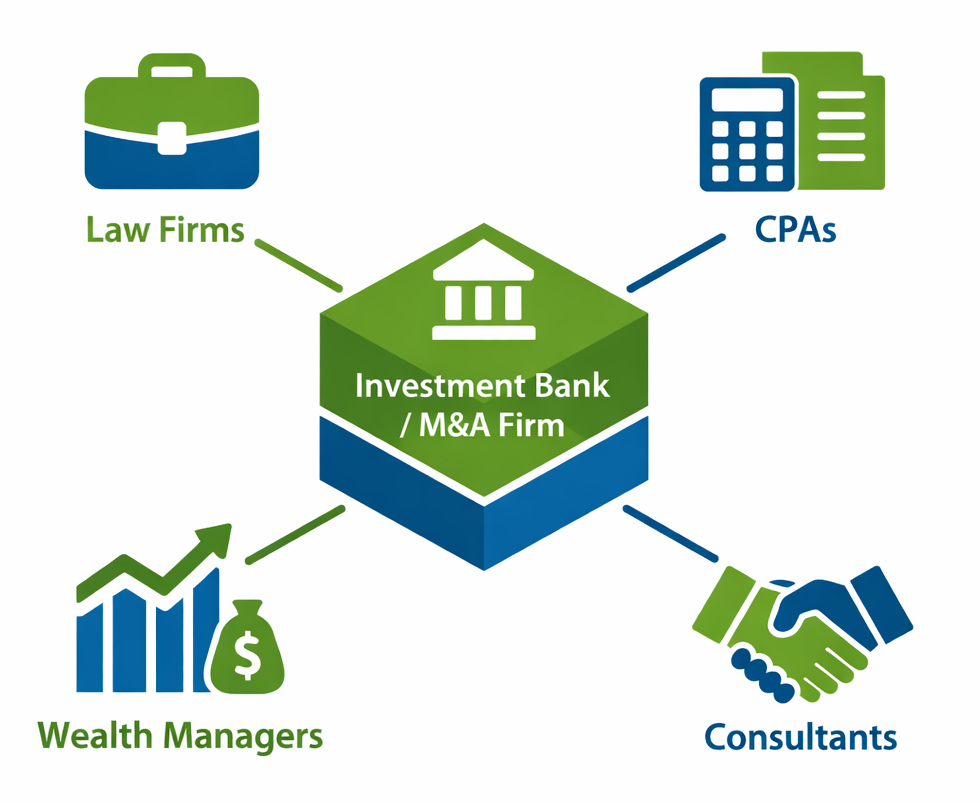
In middle-market M&A and investment banking, referral relationships still carry enormous weight. Deals do not come only from outbound prospecting, paid channels, or market visibility. They often come through trusted intermediaries: attorneys, accountants, wealth advisors, lenders, consultants, and other centers of influence who hear about opportunity before a formal process begins. Industry sources consistently describe professional networks, referrals, and intermediary relationships as foundational to deal sourcing and origination.
Despite this truth, many firms still manage these relationships informally. Everyone agrees referrals matter, but the actual system behind them is often loose, inconsistent, and hard to measure. Activity lives in inboxes, calendars, or memory. Follow-up varies by partner. Leadership sees anecdotes, not patterns. As a result, one of the firm’s best growth channels remains under-managed. This is especially risky when relationship-driven sourcing depends on long-term engagement, active outreach, and a well-maintained network to produce consistent deal flow.
The firms that get more from referrals do something different: they operationalize them.
They do not reduce relationships to a spreadsheet exercise. They simply create enough structure around the relationship engine that it becomes visible, repeatable, and scalable. Priority COIs are clearly defined. The value proposition for each referral segment is understood. Meaningful touchpoints are standardized. Introductions, meetings, opportunities, and outcomes are captured in the CRM. Once that happens, leadership can finally answer the questions that matter: Which relationships are producing qualified opportunities? Which are active but underperforming? Which have gone dormant? Which deserve more investment?
The role of networks in deal sourcing is not theoretical. Successful deal sourcing depends on actively engaging a professional network and maintaining consistent deal flow through relationship-building and database discipline. Regular interaction with one’s network creates better access to opportunities, and referrals can account for a very large share of deal flow in relationship-driven markets.
For M&A advisors, that makes intuitive sense. COIs sit close to business owners and executives at critical moments: succession questions, growth plateaus, recap conversations, partner disputes, tax changes, liquidity planning, or acquisition interest. Those signals often surface first in trusted advisory relationships, not in public databases.
When referral relationships are managed by memory, three issues appear almost immediately.
A referral relationship system is not complicated. It is simply structured enough to make relationship-based growth manageable.
It starts with priority COI segmentation. Not every relationship belongs in the same bucket. A CPA with deep access to founder-owned businesses is not the same as a private wealth advisor focused on liquidity events or a commercial banker serving lower middle-market owners. Each group sees different triggers and responds to different kinds of value.
Next comes a clear value proposition by segment. Why should this COI introduce your firm? What do they get beyond a generic promise of “good work”? In strong systems, the answer is concrete: sharper market insight, a trusted sounding board for owner conversations, access to specialists, reciprocal introductions, or a more reliable process for helping clients evaluate options.
Then comes touchpoint design. The best relationship systems do not rely on random check-ins. They define a few meaningful interactions that fit the referral source: quarterly market conversations, sector-specific updates, curated introductions, event invitations, joint roundtables, or quick outreach tied to trigger events.
Finally, the system must live in the CRM. Firms need fields and workflows for COI type, sector relevance, relationship owner, priority tier, last meaningful touchpoint, introductions made, opportunities sourced, outcomes, and reactivation status. Without that visibility, there is no real system, only a hopeful contact list.
The most effective way to build this is in four steps.
Start by identifying existing COIs, current activity levels, partner ownership, recent introductions, and known outcomes. Most firms discover they have more relationship assets than they thought, but very uneven documentation.
Sort COIs into simple categories such as strategic, active, nurture, and dormant. Prioritization should reflect market access, alignment with your ideal client profile, credibility, reciprocity potential, and recent engagement. This aligns with the broader deal sourcing principle that firms need clearly defined criteria and a refined target universe rather than a wide but unmanaged pool.
This is where many firms overcomplicate things. The goal is not to burden partners with more admin. It is to create a manageable rhythm. For example: one meaningful outreach each month for top-tier COIs, one quarterly insight or invitation, and one annual planning conversation around shared opportunity areas. The point is consistency with relevance, not volume.
Create a minimum viable reporting framework. At the relationship level, track last touchpoint, next action, and referral activity. At the opportunity level, track source, referral stage, qualification, and outcome. At the leadership level, dashboard the handful of metrics that show momentum and conversion.
If the system is working, leadership should be able to see three classes of metrics.
Leading indicators: number of meaningful COI touchpoints, partner participation rates, new COIs added, dormant relationships reactivated, and referral-source coverage by sector or geography.
Pipeline indicators: introductions received, qualified opportunities created, sourced pipeline value, and conversion rates by COI segment.
Relationship health indicators: response rates, reciprocity, time since last meaningful interaction, and share of referrals concentrated in too few relationships.
Those metrics help answer a critical strategic question: is the firm building a durable growth engine, or just benefiting from a few well-connected individuals?
In a competitive market, structured relationship management is not just an efficiency play. It is a timing advantage.
Firms gain an edge when they move upstream, use structured intelligence, and position early, before formal processes begin. That same logic applies to COI systems. When relationship activity, trigger events, and referral outcomes are visible, firms can act sooner. They can coordinate outreach around real market signals. They can connect marketing, relationship development, and origination rather than letting each operate in isolation. They can also see which conversations are turning into actual mandates and which are not.
This is where many firms discover the biggest benefit: better leadership decisions.
Once the data is there, leaders can deepen high-performing COI segments, reactivate promising but quiet relationships, reposition underperforming partnerships, and reduce reliance on anecdotal assumptions. In other words, they can manage referral growth with the same discipline they apply to pipeline reviews or strategic planning.
Referrals should not be treated as a happy byproduct of networking.
For middle-market M&A advisors and investment banks, centers of influence are too important, and too valuable, to be left to memory or chance. The firms that grow most predictably through referrals are not necessarily the most connected. They are the most disciplined. They define priority relationships, clarify value, standardize touchpoints, and track what happens next.
When relationship management shifts from “by memory” to “by design”, referrals stop being an unpredictable source of occasional opportunity. They become what they should have been all along: a visible, measurable, repeatable growth engine.
Download the COI Referral Relationship Scorecard and CRM Field Template to assess your most important referral sources, define next steps, and create the structure needed to track introductions, opportunity quality, and outcomes more consistently.
Hollinden helps investment banks build structured referral programs by evaluating existing networks, prioritizing key centers of influence, and implementing CRM-driven processes that keep relationships active and visible. We combine strategy, content, and outreach to help firms stay top of mind with attorneys, accountants, wealth advisors, and other referral partners while ensuring every interaction and opportunity is tracked and measured.
The result is a more disciplined referral process that turns valuable relationships into a more predictable source of new opportunities. Click here to learn more.
A referral relationship system is a structured approach to managing centers of influence through segmentation, defined value propositions, standardized touchpoints, CRM tracking, and outcome reporting. Its purpose is to make referral-based growth visible and repeatable rather than informal and inconsistent.
COIs are often close to the owner, executive, or investor conversations where opportunity first emerges. Industry sources consistently point to networks, referrals, and intermediary relationships as core sources of deal flow and origination activity.
At a minimum, firms should track COI type, relationship owner, priority tier, touchpoint history, introductions made, sourced opportunities, and outcomes. Without those fields, leadership cannot reliably measure relationship performance or referral contribution.
There is no single universal cadence, but top-tier COIs usually need regular, relevant touchpoints rather than occasional social check-ins. A monthly or quarterly rhythm works best when the interactions are meaningful and tied to the COI’s world, clients, and market triggers.
The biggest mistake is assuming strong personal relationships automatically equal a managed growth channel. Without process discipline and reporting, firms cannot scale what is working or fix what is underperforming.
The Hollinden Point of View brings you monthly insights tailored to helping you grow your firm.

A growth strategy consultant’s guide to scaling M&A and IB firms through deal flow, diversification, and structured frameworks.

Explore how leading private equity firms are redefining value creation by prioritizing organizational culture as a strategic asset—driving long-term...

From value creation to ESG, discover how growth strategists help PE firms maximize returns and expand assets under management.